• Active water sensor SHT 8800 analog voltage
  • Active water sensor SHT 8800 analog voltage
  • Active water sensor SHT 8800 analog voltage
  • Active water sensor SHT 8800 analog voltage
  • Active water sensor SHT 8800 analog voltage
  • Active water sensor SHT 8800 analog voltage

Active water sensor SHT 8800 analog voltage

Active water sensor SHT 8800 analog voltage

Normal price 75,00 €
Normal price Selling price 75,00 €
Sale Sold out
including VAT plus Versandkosten
  • aktiver Wassersensor fĂŒr AnalogeingĂ€nge Smarthome, GLT uvm.
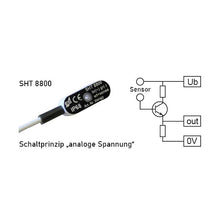
  • Schaltprinzip analoge Spannung
  • zwei V4A-Edelstahl-Kontakte, kompakte AusfĂŒhrung, zĂ€h-elastisch, schlagfest, bedingt trittsicher, korrosionsstabile Vergießung fĂŒr höchste Sicherheit und Langlebigkeit
  • zur Bodenmontage anschraubbar, Aluminium-verstĂ€rktes Bohrloch
  • 4 m LIYY-Steuerleitung 3 x 0,14 mmÂČ - maximal verlĂ€ngerbar auf 20 Meter
  • nicht geeignet fĂŒr den Anschluss an Schabus Wassermeldern
  • Discounts for specialist companies & resellers
  • Personal expert advice (no call center!)
  • Repair service beyond the statutory warranty

Item number: 200362

Delivery time: 2-3 working days

View full details
Active water sensor SHT 8800 analog voltage

Active water sensor SHT 8800 analog voltage

75,00 €
  • Description
  • Technical information
  • Downloads
  • FAQ - Frequently asked questions
  • Reviews

Scope of delivery

  • SHT 8800 active water sensor analog voltage
  • Mounting material (1 screw, 1 dowel)
  • Operating instructions

💧 SHT 8800 – Active water sensor with V4A stainless steel contacts

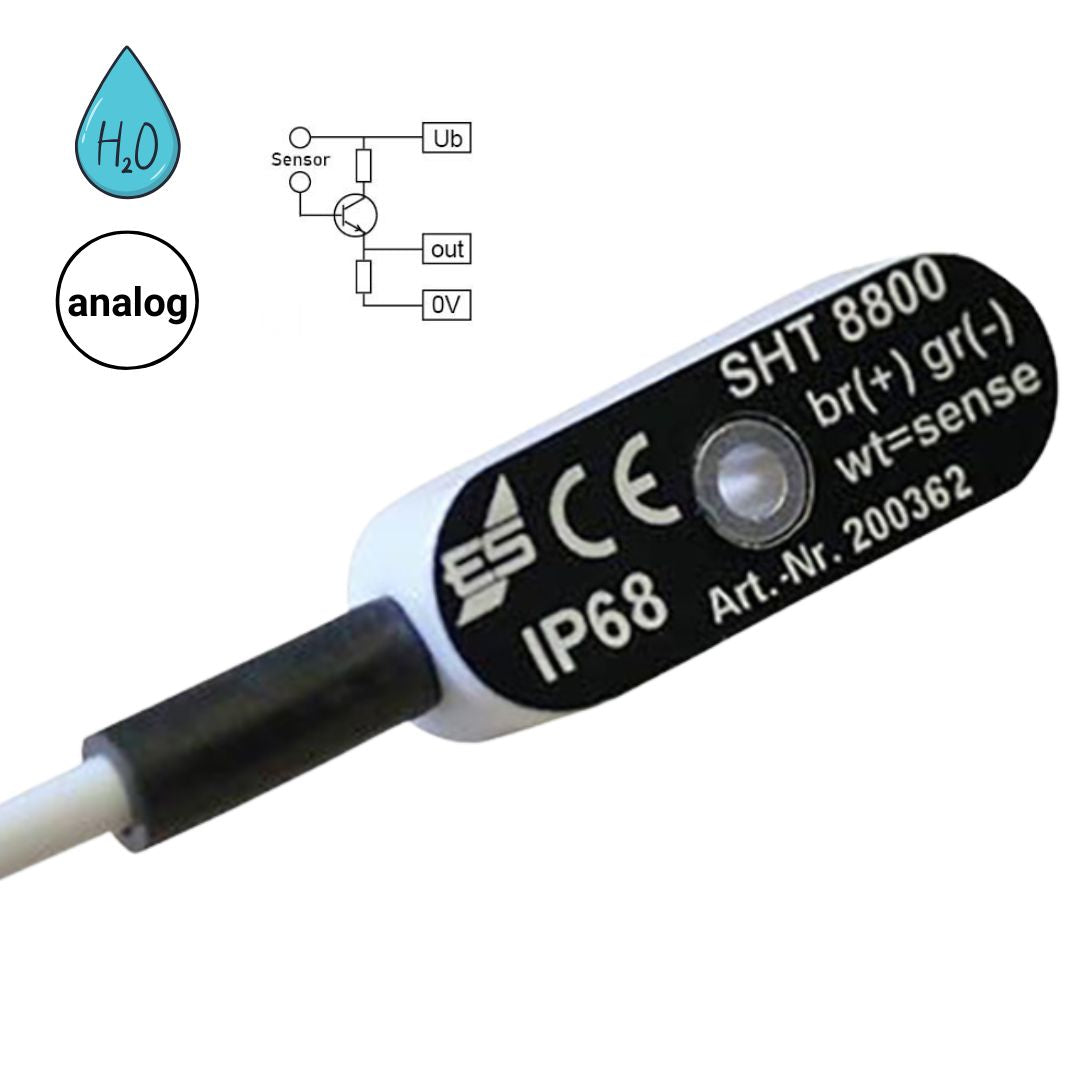
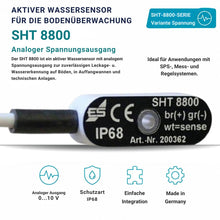
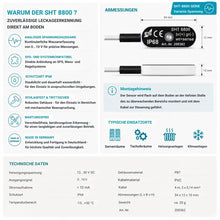
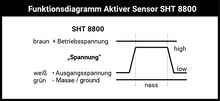
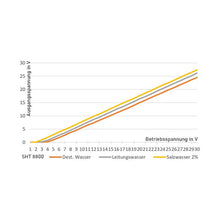
The SHT 8800 is a high-quality active water sensor with two robust V4A stainless steel contacts, encapsulated in a durable plastic housing with Wepuran¼. As soon as water or another conductive liquid touches the contacts, the output voltage rises to approximately 80–90% of the operating voltage. This allows for easy and reliable control of high-impedance analog inputs of home automation or building management systems.


⚙ Functionality and connection

  • The sensor cables (3 x 0.14 mmÂČ) are flexible and can be easily extended (max. 20 meters).

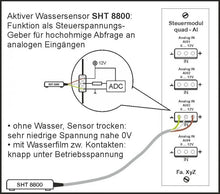
  • Important: The connected analog inputs must be high-impedance to avoid loading the sensor.

  • An aluminum-reinforced drill hole facilitates secure fastening.
  • LIYY cables are temporarily waterproof, flame-retardant, low-adhesion, self-extinguishing, and resistant to oils, greases, coolants, and lubricants.


đŸš« Not compatible with Schabus water detectors

The SHT 8800 is not suitable for direct connection to Schabus water detectors . Please note this during integration.


đŸ€– Active sensors – sensitive technology with auxiliary energy

Active sensors such as the SHT 8800 have an electronic internal component and always require auxiliary power – either through an operating voltage or a bias current to query a potential-free contact.

  • The SHT 8800 reacts to water contact with an increase in voltage.

  • Other active sensor types (e.g. SHT 8815 , SHT 8824 ) react differently (change in resistance or current).

  • Each sensor type is specifically tailored to the requirements of the respective control system.


💡 Sensitivity and area of ​​application

  • Active sensors are more sensitive than passive sensors and can also detect water with low conductivity.

  • Chemically pure, repeatedly distilled water cannot be reliably detected even by active sensors – at least some free ions must be present.

  • Suitable for regularly dry environments with rare water events.

  • In permanently humid environments, electrolysis can cause contact corrosion because the sensor operates with direct current.


🔧 Tips for a long service life

  • The high-impedance query of the sensor signals is a prerequisite for long and wear-free operation.

  • The current limit in the sensor protects against excessive wear.

WEEE NO.: DE91394868
Operating voltage 10V = 30V DC SELV/PELV
Functional area -15°C/+50°C
Protection class IP68
Dimensions(WxWxD)

10x12x34mm

Power consumption 7 V = 27 V/approx. 80% of Ub
Working principle active
Line 2m | 3x014mm2 | white

💡 What is the difference between active and passive water sensors? Active sensors like the SHT 8800 have an electronic interior and require an operating voltage. When they come into contact with water, they react with a change in the output voltage (e.g. from low to high). Passive sensors, on the other hand, work purely mechanically or conduct electricity directly when they come into contact with water.

⚠ Can the SHT 8800 be used with Schabus water detectors? No, the SHT 8800 is not Compatible with the water detectors from Elektrotechnik Schabus. It is specially designed for controls with high-impedance analog inputs (e.g. smart home systems or building management technology).

🔌 What does "high-impedance input" mean? A high-resistance input loads the sensor not measurable, that means: The sensor can only have to deliver minimal power – typically typical with TTL or CMOS logic. Stress can damage the sensor or produce incorrect readings.

📏 How far can I extend the cable? The sensor cable (3 × 0.14 mmÂČ LIYY) can easily be extended – ideally, however, not beyond approx. 20 metersTo maintain signal stability and voltage level.

💧 Does the SHT 8800 also react to distilled water? Only to a limited extent. The sensor requires a conductive liquid, i.e. water with sufficient free ions. Fully demineralized or repeatedly distilled water cannot be identified with certainty. The medium should have at least one Density of 0.7g/cm³ and have a certain conductivity.

🌊 Is the sensor suitable for permanently humid environments? No. The SHT 8800 is for dry normal environments with occasional contact with water thought. In a permanently humid environment, electrolysis can cause Corrosion of contacts come because the sensor works with direct voltage.

đŸ§Ș Which liquids can the sensor detect? The SHT 8800 recognizes all conductive liquids, e.g. E.g. tap water, salty water or coolants. Not recognizable are non-conductive media like distilled water or oils.

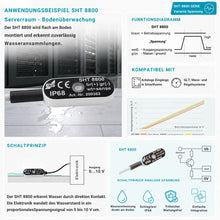
🧰 How is the sensor mounted? The sensor is mounted so that the two V4A stainless steel contacts are at the lowest point to be monitored. A defined installation position is not necessary as it reacts directly to liquid contact.

👉 A notice: For permanent and safe placement, the sensor should firmly mounted - there is a suitable in the aluminum base support Drill hole for screw connection provided.

Customer Reviews

Be the first to write a review
0%
(0)
0%
(0)
0%
(0)
0%
(0)
0%
(0)
Description

Scope of delivery

  • SHT 8800 active water sensor analog voltage
  • Mounting material (1 screw, 1 dowel)
  • Operating instructions

💧 SHT 8800 – Active water sensor with V4A stainless steel contacts

The SHT 8800 is a high-quality active water sensor with two robust V4A stainless steel contacts, encapsulated in a durable plastic housing with Wepuran¼. As soon as water or another conductive liquid touches the contacts, the output voltage rises to approximately 80–90% of the operating voltage. This allows for easy and reliable control of high-impedance analog inputs of home automation or building management systems.


⚙ Functionality and connection

  • The sensor cables (3 x 0.14 mmÂČ) are flexible and can be easily extended (max. 20 meters).

  • Important: The connected analog inputs must be high-impedance to avoid loading the sensor.

  • An aluminum-reinforced drill hole facilitates secure fastening.
  • LIYY cables are temporarily waterproof, flame-retardant, low-adhesion, self-extinguishing, and resistant to oils, greases, coolants, and lubricants.


đŸš« Not compatible with Schabus water detectors

The SHT 8800 is not suitable for direct connection to Schabus water detectors . Please note this during integration.


đŸ€– Active sensors – sensitive technology with auxiliary energy

Active sensors such as the SHT 8800 have an electronic internal component and always require auxiliary power – either through an operating voltage or a bias current to query a potential-free contact.

  • The SHT 8800 reacts to water contact with an increase in voltage.

  • Other active sensor types (e.g. SHT 8815 , SHT 8824 ) react differently (change in resistance or current).

  • Each sensor type is specifically tailored to the requirements of the respective control system.


💡 Sensitivity and area of ​​application

  • Active sensors are more sensitive than passive sensors and can also detect water with low conductivity.

  • Chemically pure, repeatedly distilled water cannot be reliably detected even by active sensors – at least some free ions must be present.

  • Suitable for regularly dry environments with rare water events.

  • In permanently humid environments, electrolysis can cause contact corrosion because the sensor operates with direct current.


🔧 Tips for a long service life

  • The high-impedance query of the sensor signals is a prerequisite for long and wear-free operation.

  • The current limit in the sensor protects against excessive wear.

WEEE NO.: DE91394868
Technical information
Operating voltage 10V = 30V DC SELV/PELV
Functional area -15°C/+50°C
Protection class IP68
Dimensions(WxWxD)

10x12x34mm

Power consumption 7 V = 27 V/approx. 80% of Ub
Working principle active
Line 2m | 3x014mm2 | white
Connection examples
FAQ - Frequently asked questions

💡 What is the difference between active and passive water sensors? Active sensors like the SHT 8800 have an electronic interior and require an operating voltage. When they come into contact with water, they react with a change in the output voltage (e.g. from low to high). Passive sensors, on the other hand, work purely mechanically or conduct electricity directly when they come into contact with water.

⚠ Can the SHT 8800 be used with Schabus water detectors? No, the SHT 8800 is not Compatible with the water detectors from Elektrotechnik Schabus. It is specially designed for controls with high-impedance analog inputs (e.g. smart home systems or building management technology).

🔌 What does "high-impedance input" mean? A high-resistance input loads the sensor not measurable, that means: The sensor can only have to deliver minimal power – typically typical with TTL or CMOS logic. Stress can damage the sensor or produce incorrect readings.

📏 How far can I extend the cable? The sensor cable (3 × 0.14 mmÂČ LIYY) can easily be extended – ideally, however, not beyond approx. 20 metersTo maintain signal stability and voltage level.

💧 Does the SHT 8800 also react to distilled water? Only to a limited extent. The sensor requires a conductive liquid, i.e. water with sufficient free ions. Fully demineralized or repeatedly distilled water cannot be identified with certainty. The medium should have at least one Density of 0.7g/cm³ and have a certain conductivity.

🌊 Is the sensor suitable for permanently humid environments? No. The SHT 8800 is for dry normal environments with occasional contact with water thought. In a permanently humid environment, electrolysis can cause Corrosion of contacts come because the sensor works with direct voltage.

đŸ§Ș Which liquids can the sensor detect? The SHT 8800 recognizes all conductive liquids, e.g. E.g. tap water, salty water or coolants. Not recognizable are non-conductive media like distilled water or oils.

🧰 How is the sensor mounted? The sensor is mounted so that the two V4A stainless steel contacts are at the lowest point to be monitored. A defined installation position is not necessary as it reacts directly to liquid contact.

👉 A notice: For permanent and safe placement, the sensor should firmly mounted - there is a suitable in the aluminum base support Drill hole for screw connection provided.

Reviews

Customer Reviews

Be the first to write a review
0%
(0)
0%
(0)
0%
(0)
0%
(0)
0%
(0)